What is pretotyping?
Pretotyping validates a product idea in days, not months — testing whether people actually want it before you build it. Here's how it works, how it differs from prototyping, the 10 methods, and the results enterprises see.
Coined by Alberto Savoia at Google, 2010 · $30M+ saved
Banked
$68M+
Fund the best, save on the rest.
What is pretotyping?
Pretotyping is a set of techniques for validating a product idea quickly and cheaply — testing whether people actually want it before you build it. Coined from “pretend” + “prototype” by Alberto Savoia at Google in 2010, it answers “should we build this?” using real customer behaviour, not opinions. It’s the fastest route to idea validation: enterprises using it (Google, AGL, PEXA) have saved $30M+ by killing bad ideas before development.
90%
of new products fail in the market
Harvard Business School / Christensen
88%
of AI pilots never reach production
MIT, 2025
$30M+
saved by enterprises killing bad ideas early
Exponentially client results
The Law of Market Failure
Most new ideas fail in the market — even when they’re built well. Alberto Savoia calls this the Law of Market Failure, and the only defence is to test demand objectively and fast, before you invest in building. That means trusting YODA (Your Own DAta) on what people actually do over the confident opinions of “Thoughtland,” and insisting on skin in the game — real clicks, sign-ups or money — as proof. It’s the same discipline behind validating any business idea.
Pretotyping tests demand. Prototyping tests the build.
The two are easy to confuse, but they answer different questions. Pretotyping comes first — it tells you whether an idea is worth building at all. Prototyping comes later, once you already know people want it. Read the full pretotyping vs prototyping breakdown →
| Dimension | Pretotyping | Prototyping |
|---|---|---|
| Question it answers | Should we build this? Will anyone want it? | Can we build this? Does it work? |
| What you test | Real market demand and customer behaviour | Functionality, feasibility and usability |
| What you build | Little or nothing real — a fake door, a façade, a stand-in | A working approximation of the actual product |
| Typical cost | Hours to days, often near-zero spend | Weeks to months, real engineering budget |
| When you use it | Before you commit to building | After you've decided it's worth building |
How to run a pretotype
Five steps take you from a fuzzy idea to a Stop, Pivot or Proceed decision backed by real behaviour.
Frame the Key Market Hypothesis
Name the market belief you're actually betting on — who the customer is and what you expect them to do.
Say it with numbers (the XYZ hypothesis)
Rewrite it as 'At least X% of Y will do Z.' A measurable bar turns a hope into a test you can pass or fail.
Set your pass/fail threshold
Decide the number that means proceed — and the number that means kill — before you run it, so the data can't be argued away.
Shrink it to a Hypozoom
Build the smallest, cheapest believable version that still produces real behaviour, then pick a method — Fake Door, Mechanical Turk, and so on.
Run it, then Stop, Pivot or Proceed
Collect real skin-in-the-game data — clicks, sign-ups, money — and let the threshold, not opinion, decide the idea's fate.
Pretotyping in two minutes
Leslie Barry on the one question pretotyping answers — should we build it? — and why it beats prototyping for testing demand.
From the free Learn Pretotyping series. More on Leslie Barry's channel →
Pretotyping in the wild
Six pretotypes that answered 'should we build it?' before anyone spent big — the moves behind Palm, IBM, Airbnb and more. See all examples →
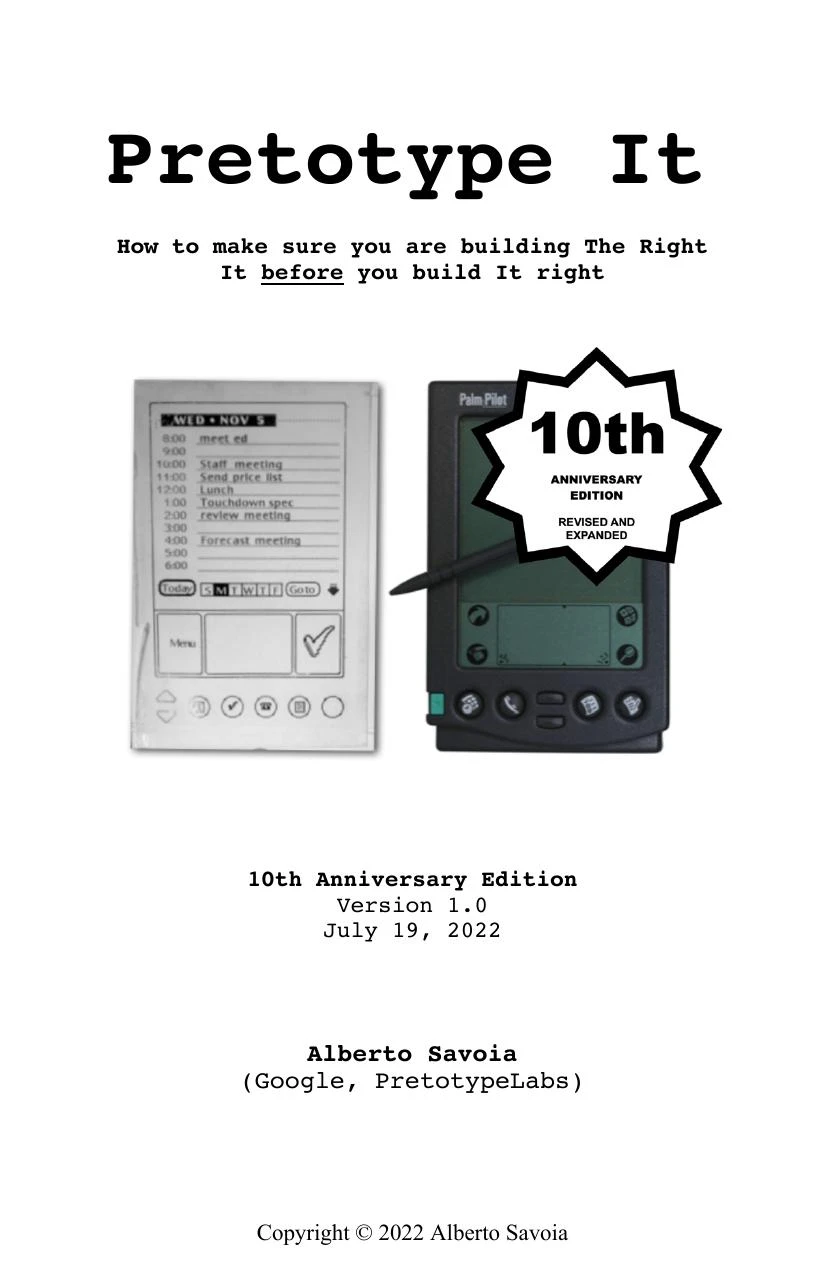
Palm Pilot
Jeff Hawkins carried a block of wood for weeks, pretending to check his calendar on it, to prove he'd actually use a pocket organiser before building one.
IBM speech-to-text
IBM faked a working dictation machine with a hidden typist. Buyers loved the demo but quit within hours — sore throats, too much noise — saving years of wasted build.
Second Day Sushi
Our own test: 'at least 20% of sushi buyers will buy day-old sushi at half price.' Almost nobody did, so we killed the idea in days, not quarters.
Airbnb
The founders rented out air mattresses in their own apartment to test whether strangers would really pay to sleep in a spare room.
Google Glass
A concept video stood in for the finished product, gauging real demand and sign-ups long before any mass manufacturing.
Skincare AI
A beauty brand tested an AI makeup recommender with a Fake Door, then a Mechanical Turk, adding cost only after each result proved demand.
The 10 pretotyping methods
Each method is a fast, cheap way to collect real behavioural evidence — proof people will act, not just say they like the idea. See the full methods guide →
The Mechanical Turk
Replace expensive technology with humans behind the scenes to test demand before you automate — the core of a Wizard of Oz test.
The Pinocchio
Build a non-functional, lifeless version and use it as if it were real to test how often you'd reach for it.
The Fake Door
Advertise the offering and measure clicks or sign-ups for something that doesn't exist yet.
The Façade
Stand up a convincing front-end or landing page and count the people who try to buy or sign up.
The YouTube
Demonstrate the idea in a short video and gauge interest from views, shares and sign-ups.
The One-Night Stand
Offer the service for real, but only once or for a short window, to see if anyone actually shows up.
The Infiltrator
Slip the product into a real retail or usage environment and watch whether people engage with it.
The Re-Label
Put a new label on an existing product to test whether a new positioning or use-case lands.
The Provincial
Test in one small, local market first before assuming the idea will scale everywhere.
The Minimum Viable Pretotype
Strip the idea to the single riskiest assumption and test only that, as cheaply as possible.
Go deeper on pretotyping
Everything in the pretotyping toolkit — real examples, free tools, the individual methods, and how it fits into validating an idea.
Pretotyping examples
Dropbox, Zappos, PEXA and AGL — real pretotyping examples that proved demand before millions were invested.
Pretotyping tools & templates
Free experiment templates, a Lean Canvas generator and the AI Idea Validator to run your first pretotype today.
The 10 pretotyping methods
The full methods guide — Fake Door, Mechanical Turk, Pinocchio and more, with when to reach for each.
Pretotyping vs prototyping
The full breakdown of when to fake demand and when to build a working model of the product.
Idea validation, end to end
Where pretotyping fits in the wider process of validating an idea before you commit budget to it.
How to validate a business idea
The step-by-step playbook for turning one idea into real customer evidence in days, not months.
Pretotyping, answered
What is pretotyping?
Pretotyping is a set of fast, cheap techniques for validating whether people actually want a product idea before you build it. Created by Alberto Savoia at Google in 2010, it uses real customer behaviour — clicks, sign-ups, purchases — to answer 'should we build this?' rather than relying on opinions or surveys.
What's the difference between pretotyping and prototyping?
Pretotyping tests demand: will anyone want this? It comes first and costs almost nothing. Prototyping tests the build: can we make it work? It comes later, once you already know there's demand, and requires real engineering effort. Pretotyping stops you from prototyping ideas nobody wants.
How do you write a pretotyping hypothesis?
Use the XYZ format — 'At least X% of Y will do Z' — so success is a number, not an opinion. For example: 'At least 20% of packaged-sushi buyers will buy day-old sushi at half price.' Setting that threshold before you run the test means the result can't be argued away afterwards.
What is the Law of Market Failure?
It's Alberto Savoia's observation that most new ideas fail in the market even when they're competently built — the market simply doesn't want them. The only reliable defence is to test demand quickly and objectively, with real behavioural data (YODA — Your Own DAta), before investing in development. Pretotyping exists to fight this law.
What is a Hypozoom?
A Hypozoom is the smallest, cheapest believable version of your idea that still produces real customer behaviour. Instead of building the whole product, you zoom in on the single riskiest assumption and test only that — often with a Fake Door or Mechanical Turk — so you get a genuine signal for almost no cost.
Who invented pretotyping?
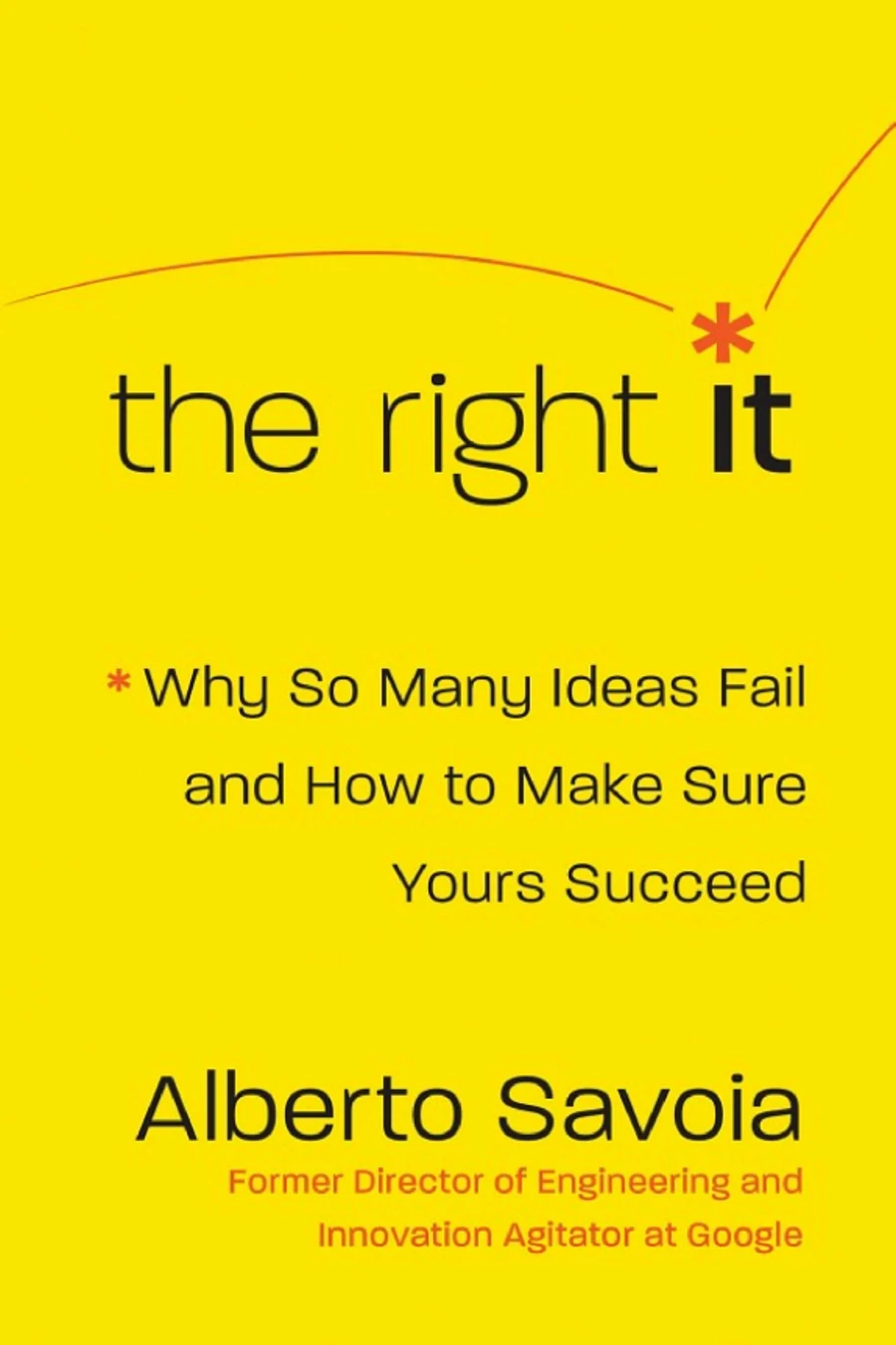
Pretotyping was coined and developed by Alberto Savoia, a former Engineering Director and Innovation Agitator at Google, around 2010. He wrote the book 'The Right It', and the method is now taught at Stanford and used by enterprise innovation teams worldwide.
What are the pretotyping methods?
The classic pretotyping methods include the Mechanical Turk, the Pinocchio, the Fake Door, the Façade, the YouTube, the One-Night Stand, the Infiltrator, the Re-Label, the Provincial, and the Minimum Viable Pretotype. Each is a different way to collect real behavioural evidence quickly and cheaply.
How is pretotyping different from an MVP?
An MVP (minimum viable product) is still a real, working product you build and ship — it tests whether people will use and pay for a functional version. A pretotype is built before any product exists and often isn't functional at all; it tests raw demand. Pretotyping happens earlier, faster and cheaper than building an MVP.
Bring us one idea. We'll tell you if it's worth building.
Twenty minutes with Leslie Barry. We look at one idea on your roadmap, the evidence you already have, and whether pretotyping is a useful next step. No pitch.